Research
Our work sits at the intersection of medicinal chemistry, molecular biology, biochemistry and chemical biology. We use techniques from different fields to answer questions about transcriptional regulation in cancer. Each project below is open to students, whether you are exploring research for the first time or planning a doctoral thesis.
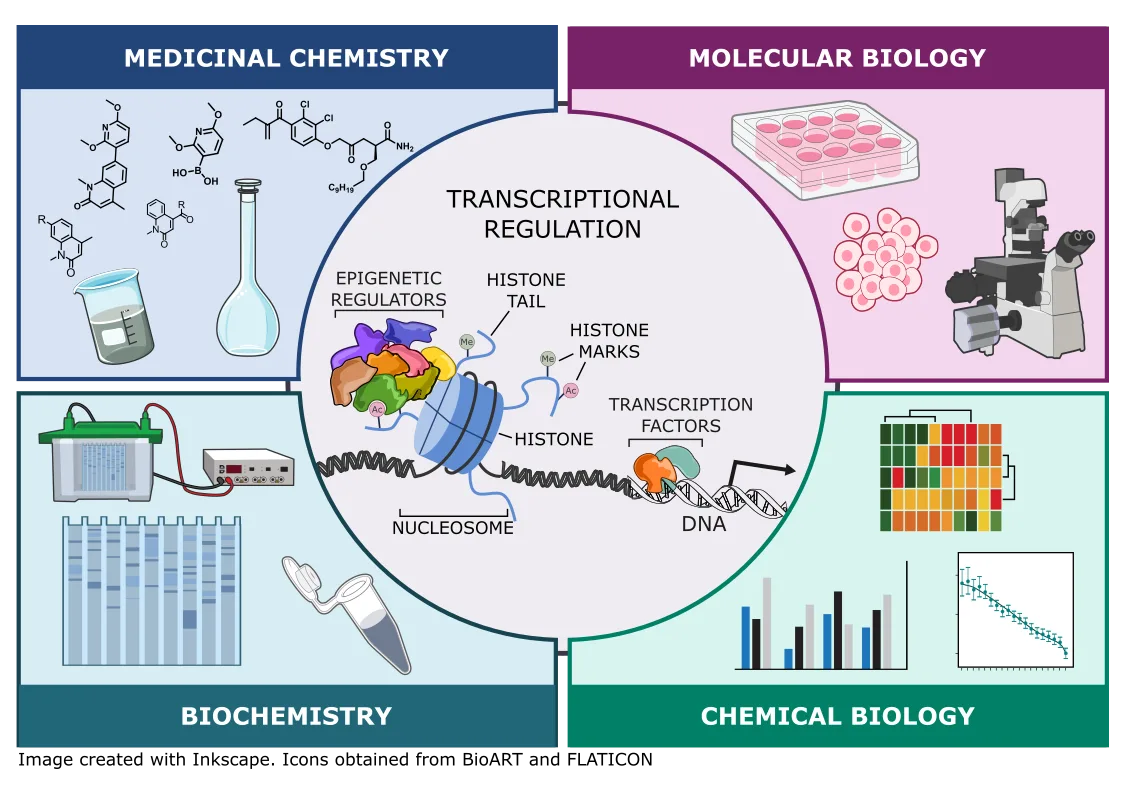
Target-based drug development of reversible covalent inhibitors
To combat cancer, we are engineering small-molecule inhibitors that disrupt the transcriptional regulation machinery driving progression. This project focuses on bromodomain-containing proteins, readers that interpret cellular signals by recognizing acetylated lysine on histone tails. The classic challenge in targeting these proteins is finding a drug that is selective for the bad actor among many similar bromodomains. We overcome this bottleneck by employing a dual approach: target-based drug development paired with reversible covalent chemistry. This allows us to design molecules that bind selectively to non-conserved amino acids within the target protein.
Mechanistic studies on the function of transcriptional regulators in cancer
New anticancer drugs are approved rapidly, yet severe side effects persist because we still don’t fully understand how these molecules act inside a complex, living cell. The more we understand about the biology of the characters that drive progression, the safer the drugs can be developed. We leverage chemical probes already validated as highly potent and selective binders for transcriptional regulators to unveil the mechanisms behind their function in cancer. Our studies are focused on cell-based models as a handy tool to simulate the native function of the target proteins in cancer cells.
See a project you'd like to join?
Tell us which area interests you. We welcome PhD students and undergrads of all levels.